 Personal Education
Home > NatickFOSS Demos
NatickFOSS Demos

Dick and Jill Miller of Miller Microcomputer Services founded a group of Free Open Source Software (FOSS) explorers on the first Thursday of the month.
Since 2020, because of the COVID-19 pandemic, we are meeting virtually 3pm-5pm using Jitsi Meet.
The meetings offer information for computer beginners, serious users, and explorers.
I hope to be a regular participant at the meetings. From time to time, I'll do a demo about something. Anything I demo will be posted here, generally as a web page or a PDF document. There may also be a "source" document which you can easily modify to your needs. Source documents will probably be Open Document Format (ODF) which can be opened using LibreOffice. My documents will typically be released using a Creative Commons license, either CC-BY which expects you acknowledge the original author in any reuse you might do, or CC-Zero which places the material into the public domain and doesn't ask anything of you [1].
Natick FOSS Meeting "Demos"
April 2026
FOSS at SOSS Buttons (a PDF file) and a more general page about making buttons.
January 2026
September 2025
April 2025
February 2025
August 2024
November 2023

August 2023
Using Web Feeds - A practical demo using Thunderbird.
June and July 2023
Making Web pages with HTML code, Styling your web pages with CSS and Using Javascript to provide interactive features.
May 2023
Wordiply - Can you find the longest word with a small starter word in it?
March 2023
Web Image Formats: keeping pictures under control
January 2022
Wordle: a word guessing game
September 2021
Introducing Inkscape 1.1 (part 3): Making a Clipart with Text
August 2021
Introducing Inkscape 1.1 (part 2): Paths - Introduce paths and color
July 2021
Introducing Inkscape 1.1 (part 1): The Basics - working with vector graphics
May 2021
Tiny Tools Directory - tools for almost every odd task.
April 2021
Mastodon for NatickFOSS - Keeping us in touch "socially"
November 2020
Mobilizon: Group Organizer - a Free Software tool for meeting announcements and group organization.
June 2020
The Fediverse - Distributed Social Networking (No Silos Here)
A Web Slideshow - use keyboard arrows to move through the slides.
Announce the Intro to Computers Manual for Ubuntu 20.04
A Web Slideshow - use keyboard arrows to move through the slides.
Announce the Intro to Computers Manual for Ubuntu 20.04
January 2020
Pinebook/Pinebook Pro - preliminary reactions to the Pro model.
November 2019
File Systems - a gentle, not-too-technical review of Canonical's ZFS option in Ubuntu 19.10
September 2019
Day against DRM October 12 - Digital Rights (Restrictions) Management
DRM Fails to Live Up to Its Promise
DRM Fails to Live Up to Its Promise
July 2019
Two links of interest.
MIT to GPL - Why to choose the Golden Rule as an approach to software.
UNIX 50th Anniversary UNIX Retrospective on 50th anniversary on SDF, a site running on UNIX.
MIT to GPL - Why to choose the Golden Rule as an approach to software.
UNIX 50th Anniversary UNIX Retrospective on 50th anniversary on SDF, a site running on UNIX.
April 2019
Science on State Street - Six intrepid group members braved chilling wind gusts to show off FOSS to a bunch of people at Framingham State. Better weather would have been nice for this second year at the event, but we didn't lose the canopy in spite of the wind.
January 2019
Pinebook laptop
If you are not in a rush to get one, this $100.00 netbook laptop is a good deal for the price.
If you are not in a rush to get one, this $100.00 netbook laptop is a good deal for the price.
June 2016
Supporting a Community
First learn from others, then support another who wants to learn. Help them thrive in learning FOSS. Then, when you support the developers, you keep the updates coming.
First learn from others, then support another who wants to learn. Help them thrive in learning FOSS. Then, when you support the developers, you keep the updates coming.
September 2015
Bugs in a Program
What to do?
What to do?
January 2015
Stenciling and Silhouettes with Inkscape
Remixing a photo to make a vector graphic
Remixing a photo to make a vector graphic
October 2014
Unity Desktop Launchers
You ask the questions. Sometimes we find the answers.
Portable Presentations
S5 uses HTML, JavaScript and CSS to let you present anywhere with just a thumb drive and any computer with a browser.
You ask the questions. Sometimes we find the answers.
Portable Presentations
S5 uses HTML, JavaScript and CSS to let you present anywhere with just a thumb drive and any computer with a browser.
May 2014
You don't own your copy of an ebook and DVDs are locked down.
January, 2014
Taking photos of documents and 3-D objects is the trick, here.
August 1, 2013 - Dick and Jill are on vacation. We're on our own.
Introducing phpbb, a FOSS forum package. We'll begin exploring the system on a live "demo" during the meeting. Maybe the group will decide we should go further.
Exploring Inside Ebooks ePUB and Mobi in Nooks and Kindles
SeaPerch ROV Open source hardware, robotics and science
February 7, 2013 - Intro to Computers with Ubuntu Unity
The guide introduced last June has been updated to a Web version as requested.
More feedback from everybody is the next step.
January 3, 2013 - Updating our Promotional CardMore feedback from everybody is the next step.
With the move to the new
Community/Senior Center, it seems appropriate to look at our
promotional handout "business" card to bring it up to date. Follow the link to see some possible versions.
Should NatickFOSS have computer case stickers? Bumper stickers?
Should NatickFOSS have computer case stickers? Bumper stickers?
December 6, 2012: Making a Christmas Lightbulb with Inkscape

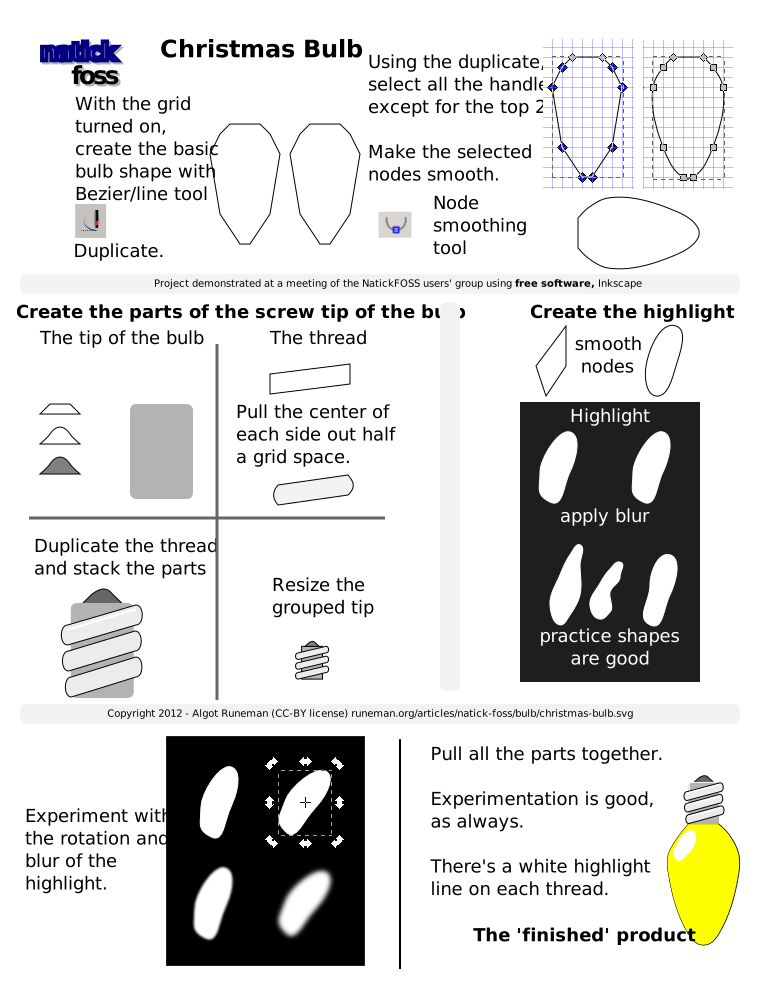
November 1, 2012: Making a Logo with Inkscape. (HTML only at this time.)
October 11, 2012: Install Fest Demo Guide (HTML only at this time)
We hope to schedule a November Install
Fest at the new Senior/Community Center and perhaps at Natick High
School. This guide is to help prepare NatickFOSS members to participate
in the install fest.
Comparison LTS vs 6-month releases. Handout PDF - ODT Why some at install fest may want to choose one over the other.
Comparison LTS vs 6-month releases. Handout PDF - ODT Why some at install fest may want to choose one over the other.
June 7, 2012 Drafting a Natick Senior Center Ubuntu Computer Guide
AnswerGarden: Feedback for the question Software Freedom is...
9 WordCloud Generators (link to blog post by Michael Gorman)
Get some free Ubuntu stickers for your computers: https://www.system76.com/community/stickers/
Changing a File Association (in Windows) so double clicking the file will launch LibreOffice for and .odt file
What does "Open Source" Mean? - guest post to Questions About Technology blog
May 3, 2012 Discussion of ebook lockdown with DRM. Handout - PDF
February 1, 2012: Charting with Spreadsheets (Final Wednesday Meeting before the change to Thursdays)
Handout - PDF - ODT (Practice Files this time, too)
January 4, 2012: Alternate Desktops
Handout - PDF - ODT
September 7, 2011: A Brief Peek at Inkscape
Handout - PDF - ODT
August 3, 2011: Earthquake Detector with Arduino
Handout - PDF - ODT
July 6, 2011: Scratch - A programming experience for almost everyone.
Demo Handout - PDF - ODT [2]
"Can't Catch Me" Car program Scratch file (will only be fully useful if you also have the Lego kit 9580 from Lego Education.)
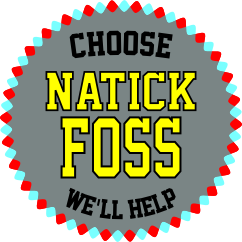 |
This
button is for use on a Web site. It could also be made into an actual physical button or sticker to wear at your next meeting. PNG - SVG |
 |
Logo from 2013 PNG - SVG (Note that the SVG does not display well in a browser. Download) |
 |
Old Logo for the group PNG - SVG |
 |
Another logo idea PNG Created using the free font, MAINFRAME BB |
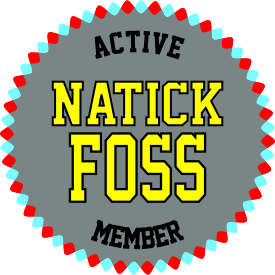 |
This
button is also for use on a Web site, but might also be a button to
make physically to wear around town. |
 |
Another version of a Web site
button. More like the standard Web site "button" design. Right click and "Save As" for this image will give you the PNG version 300px wide Left click will give you the SVG image for the whole "page" and "Save page" will download the SVG. |



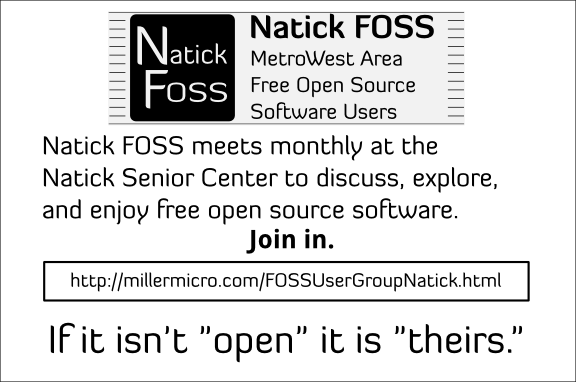
Business Card to print and distribute around town (Ask for some at the next meeting).
Front
Back
Please also explore the other parts of this website for articles and tips not presented specifically at the Natick FOSS meetings.
Note [1]: Creative Commons is an organization whose purpose it is to make clear definitions for document sharing. It is a complement to copyright, which typically confers (reserves) all rights to the document's author(s). Standard copyright prevents you from making copies or creating a derivative work based on the expression of the original document. Creative Commons has several licenses working from the most liberal, CC0 to licenses like the CC-BY-NC-ND which limits you to making copies but not incorporating the work into commercial projects, not making changes and acknowledging the original author.
Note [2]: ODT stands for the open document text format. It is similar to seeing a file with the .DOC extension. Files with the .DOC extension are in a format created by the Microsoft Corporation and used in their popular word processor, MSWord. ODT files are designed to be opened by any program which recognizes the formats of the Open Document Format (OASIS). Though I currently use LibreOffice for my word processor, ODT files should be openable by OpenOffice, Calligra, and other word processors. Recent versions of Microsoft Word do open ODT files, apparently (limits). A list of ODF compliant software is available on Wikipedia: http://en.wikipedia.org/wiki/OpenDocument
Note [3]: SVG is a vector graphic format. SVG is an emerging standard for doing images which are size-independent and focused on non-photo images. GIF/PNG/BMP/JPG/JPEG are not going to show up well if you change their size, becoming blocky or losing detail. Some files from demo materials may be best provided in SVG format.
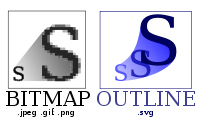 [image from Wikimedia
Commons user: Yug]
[image from Wikimedia
Commons user: Yug]SVG files are intended to redraw within the dimensions chosen, doing the best possible image for the size requested. SVG files are generated by programs like Inkscape, which is one I frequently use. Wikipedia has an extensive list of SVG editors http://en.wikipedia.org/wiki/List_of_vector_graphics_editors.